
RESEARCH & REPORTS
Featured





The New Jersey Birth Equity Funders Alliance was launched to support the implementation and impact of Nurture NJ — an initiative with goals to eliminate disparities and reduce maternal mortality. By 2026, the state had signed over 70 maternal and infant health bills into law, 80% of Nurture NJ policies had been operationalized, and the state had risen from 47th in the nation in maternal mortality to 25th.
This summary distills findings from a Princeton School of Public and International Affairs’ Policy Task Force. Raquel Mazon Jeffers and Wendy McWeeny were part of a team from CHAP that led the task force, which examined Nurture NJ’s multi-pronged effort to make the state the safest place in the nation to give birth and raise a child, specifically by centering the goals of the New Jersey Maternal and Infant Health Innovation Authority (MIHIA).
Narrative two-page overview and sample invitation to join for the SOBE project.
This report reflects on progress towards birth equity made by funders and partners in nine states and insights process-gleaned insights on the value of collaboration.
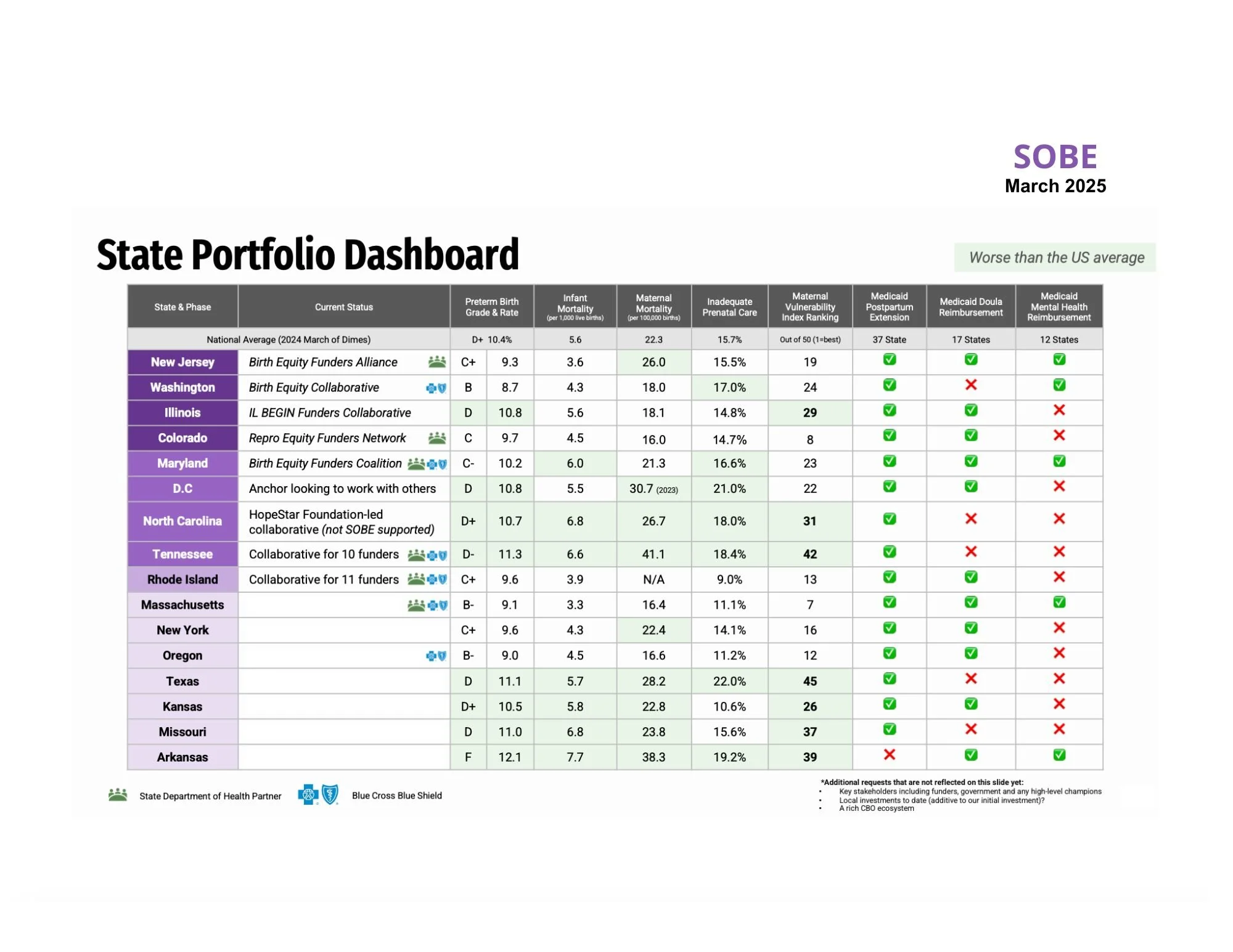
An overview of maternal and infant health rankings, Medicaid programs, and funder collaborative status for 16 states across the country.
The State Exchange Convening spotlighted the power of cross-sector partnerships—between philanthropy, state governments, payers, and community leaders—to drive meaningful systems change. This report distills insights from the first-of-its-kind gathering, sharing field-led innovations and funder practices shaping impact across 47 states and D.C.
This report from the New Jersey Health Care Quality Institute lays out the different coverage rules for perinatal care in New Jersey based on a person’s insurance status, identifying policy changes that would close existing gaps. Report supported by CHAP, the New Jersey Birth Equity Funders Alliance, and the Community Foundation of New Jersey.
As state policymakers began extending continuous eligibility for postpartum Medicaid coverage from the 60 days following birth to the 12 months following birth in 2022, a small workgroup of funders connected to explore what philanthropy’s role could be in strengthening maternal health outcomes and how we might support effective implementation of the extension.
This report from the Center for Health Care Strategies examines access to care challenges for individuals with mental health disorders and/or Substance Use Disorders and outlines recommendations for evidence-based, person-centered perinatal services. The report highlights innovative, community-rooted programs that seamlessly integrate services through a no-wrong-door approach. These examples and recommendations can guide states, health plans, health systems, providers, and community-based organizations in improving maternal health and building healthier futures for all.
Across the nation, states are pursuing strategies to meet Medicaid members’ health and social needs, including coverage and requirements for deploying community health workers (CHWs). Because CHWs can build trust and connect members to resources for whole-person care, they are ideally positioned to help identify and address these needs and provide insights into how programs can be designed to meet community member needs. This brief offers guidance to help managed care organizations (MCOs) and Medicaid agencies—along with providers, community-based organizations, and funders—incorporate CHW expertise in the design, implementation, and quality improvement of CHW programs. Brief supported by CHAP.
This issue brief highlights opportunities for funders to: help identify and advance a holistic standard of postpartum care, understand the status of coverage for that care, and identify the unique role of funders in advancing implementation. The brief shares key gaps in services and outlines opportunities to provide more comprehensive postpartum care that is inclusive of social and economic needs alongside medical and behavioral health. Brief supported by CHAP, Merck for Mothers, and Pritzker Children’s Initiative and produced by Afton Bloom.
This report from Funders for Birth Justice & Equity focused on who makes up the current landscape of maternal health philanthropic funders, what they are funding, and how they are advancing improved outcomes for all in their practices and approaches.
Pulled from a SOBE collaborative workshop, these slides offers useful definitions for key terms along with questions to guide related stakeholder conversations.
This resource synthesizes key takeaways from the national “Doula and Perinatal Community Health Worker in Medicaid Learning Series,” a virtual program which took place between 2022 and 2023, spotlighting state successes, challenges, and lessons learned when designing and implementing a Medicaid benefit for community-based perinatal support. The learning series and this outcome document were designed to leverage existing resources and learn from those most deeply engaged in and impacted by this topic, while making the content as actionable as possible for Medicaid stakeholders. Report supported by CHAP and Every Mother Counts.
In 2022, a group of private funders came together to organize this summit as a first step towards strengthening their commitment to maternal health. This report captures themes and practical recommendations in support of improving outcomes for mothers across the U.S.